Overview
Cryopreservation has become an important and accepted tool for long-term germplasm conservation of animals and plants. To protect genetic resources, repositories have been developed with national and international cooperation. For a repository to be effective, the genetic material submitted must be of good quality and comparable to other submissions. However, due to a variety of reasons, including constraints in knowledge and available resources, cryopreservation methods for aquatic species vary widely across user groups which reduces reproducibility and weakens quality control. We have developed a standardizable freezing device produced using 3-dimensional (3-D) printing and introduce the concept of network sharing to achieve aggregate high-throughput cryopreservation for aquatic species. Through this approach, identical components can be accessed globally, and we demonstrated that 3-D printers can be used to fabricate parts for standardizable freezing devices yielding relevant and reproducible cooling rates across users. With standardized devices for freezing, methods and samples can harmonize into an aggregated high-throughput pathway not currently available for aquatic species repository development.
In general, as most plastics are cooled towards cryogenic temperatures, they become harder, stiffer, and more brittle to mechanical loads, as evidenced by shattering of plastics following cooling with liquid nitrogen (LN2). Except for a few polymers specifically formulated for cryogenic applications, plastics exhibit a decrease in tensile elongation (degree of stretch prior to breaking) as temperature decreases. Also as plastics are cooled there is an increase in the elastic modulus (ratio of elongation per applied stress, often described as stiffness). Depending on formulation, plastics will undergo a ductile-to-brittle transition at some point below 0°C, and will fail by snapping rather than deforming. In our experience, objects 3-D printed with PLA can undergo considerable elongation prior to breaking, with spring-like designs remaining flexible at LN2 temperatures. Even when cooled, these objects display elastic behavior rather than undergoing irreversible plastic deformation, making them useful in low-temperature environments. These traits enable printing of multi-component devices with flat platforms to hold samples that can be assembled in multiple configurations to provide a range of cooling rates. We refer to this category of apparatus as a Positional Platform Cooling Device (PCPD).
Two prototypes of PCPD devices have been developed and tested, naming the CryoKit and Cajun Ejector. The CryoKit (Fig. 1) was developed to freeze samples in French straws or vials with LN2 in a standardized polystyrene cooler. Preliminary temperature measurements from thermocouples placed in straws indicate that reproducible cooling rates can be achieved in the range of 4-40°C/min by adjusting the configuration and height above the LN2. We are actively optimizing the current prototype.
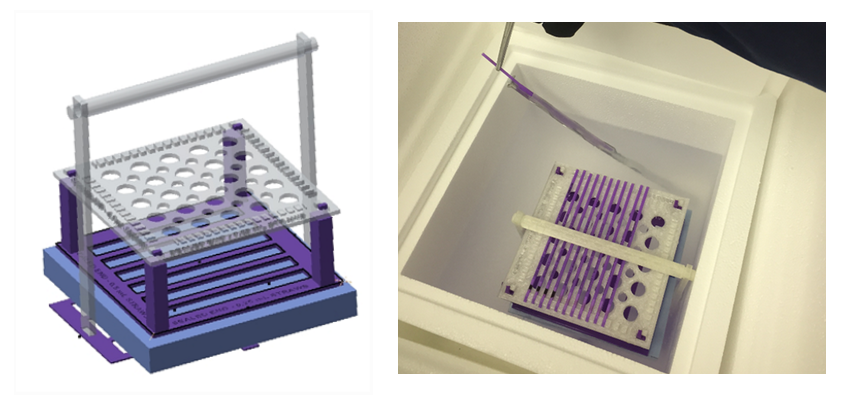
Fig. 1. A 3-D printed CryoKit (left) that freeze samples in French Straws with standardized cooling rates by use of liquid nitrogen and a standardized polystyrene cooler (right).
The Cajun Ejector device (Fig. 2) aimed to use 3-dimensional (3-D) printing to develop a standardized freezing device that can be used with nitrogen vapor shipping dewars for on-site cryopreservation of germplasm from aquatic organisms, especially threatened and endangered species. We designed multiple variations of devices using computer-assisted drafting software and prototyped the most promising designs by 3-D printing using polylactic acid (PLA) filament for fused deposition modeling. The designs were fabricated and tested for the engineering performance and cryobiological responses of selected prototype devices using in-house alpha testing, followed by on-site beta testing with cooperators, and optimization trial. Instruction materials were developed for use of the device for widespread application by use of manuals, training videos, and website resources.
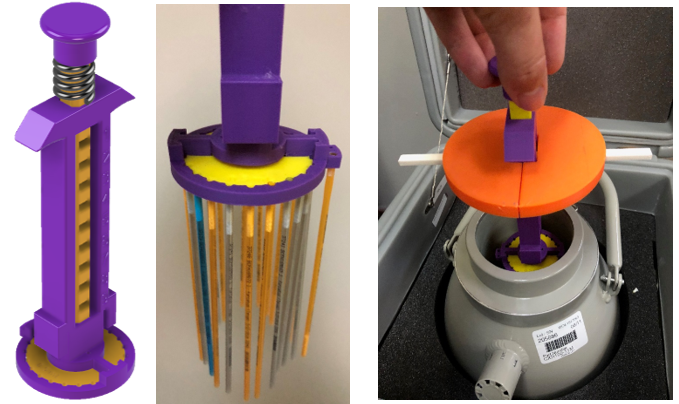
Fig. 2. A 3-D printed Cajun Ejector to freeze sperm sample in French Straw or Vials by use of a shipping dewar.