Overview
The Eastern oyster, Crassostrea virginica, is native to the waters off of the Eastern United States and Canada. Wild Eastern oysters form oyster reefs that protect shorelines from wave action and provide habitat for juvenile fish. Eastern oysters are also grown commercially in aquaculture operations along the east coast of North America, down through the Gulf of Mexico. Louisiana has a proud and storied history of farming oysters dating back to the early 1800s. The estimated profit from Louisiana oyster farming in 2017 was $84.4 million (National Marine Fisheries Service 2017).
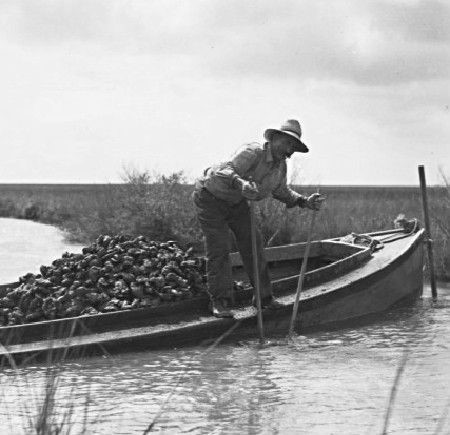
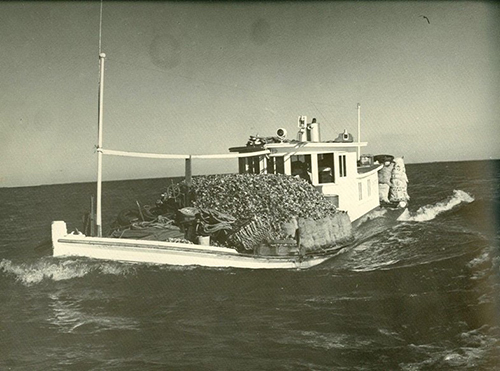
Left: Historical Louisiana oyster fishermen using tongs to find oysters. Right: Historical oyster boat with cages and oysters on the deck. https://www.pinterest.com/pin/788552215975103505/?lp=true
Despite this history of success, recent events (such as Hurricanes Katrina and Rita, and the 2010 Deepwater Horizon oil spill) have taken a toll on native oyster populations and the oyster farming industry. The AGGRC has been working for over 20 years to preserve the genetic lines of native Louisiana oysters. Cryopreservation (or freezing) of oyster sperm can indefinitely preserve genetic material. When needed, the genetic material can then be easily distributed to oyster hatcheries to spawn oyster seed for conservation or farming purposes. The AGGRC has pioneered techniques to effectively and consistently cryopreserve oyster sperm. Research continues to help ensure the future of Louisiana oysters and to help farmers maintain the traditions of farming them. (Paniagua-Chavez et al. 1998, 2000, 2001).