Overview
The printed circuit board (PCB) is one of the essential components of most electronic systems. PCB boards are composed of conducting patterns formed on an insulating substrate, mostly FR4 (fiberglass interwoven with epoxy resin). Electronic components such as semiconductor chips, capacitors, and resistors can be soldered on a designed footprint on the board, and traces of conducting materials links them to each other. Considering the chemical, thermal, and mechanical stability of the PCB board, they have the potential to be used for developing sensors at low cost for undesirable sensing conditions such as ultra-low temperatures.
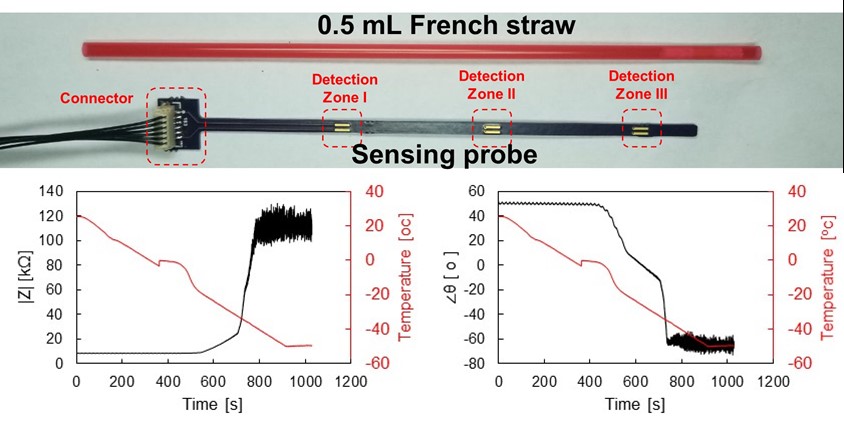
Since the introduction of the electrical impedance concept, it has gained popularity as a powerful tool for practical applications such as analysis of electrical properties of bulk materials and biological cell suspensions. We have developed multiple impedance sensing probes, that can be employed in order to monitor the cryopreservation processes. Thes impedimetric sensors are capable provide information about the freezing and thawing conditions as well as the sample composition. The probes are working with our portable impedance measurement system.